
If you’ve ever hopped off an inversion table feeling worse instead of better—tighter, dizzy, or just…off—that’s a strong clue you might not be using it quite right. I’ve been around inversion therapy long enough to see the common mistakes people make, especially when they dive in without a plan or jump too deep too fast.
Inversion tables can be excellent tools for spinal decompression, back relaxation, and temporary pressure relief… but only when used correctly. Used incorrectly, they can create new problems or exacerbate old ones.
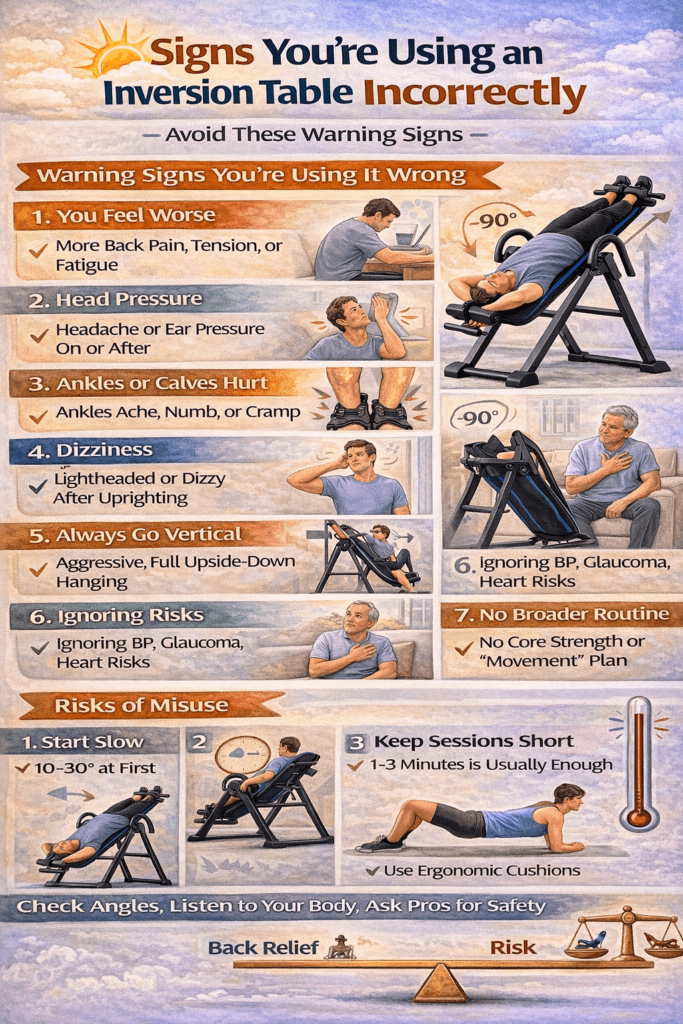
Today, I want to walk you through the most common signs you’re using an inversion table incorrectly — why they happen, how to adjust your approach, and how to use inversion safely and effectively.
What Good Inversion Use Should Feel Like
Before we talk about the red flags, let’s set expectations:
When used correctly, inversion therapy should feel like:
- Gentle spinal elongation
- Mild pressure relief
- Relaxation of back muscles
- Better mobility afterward
If instead you’re experiencing pain, discomfort, or other problems, that’s your body communicating that something isn’t aligned with your use or your body’s needs.
1. You Feel Worse After a Session (Not Better)
A lot of people assume inversion must feel intense to be effective. This isn’t true.
If you feel:
- Back pain that is sharper after you finish,
- New low back tension several hours later,
- Persistent discomfort the next day,
that’s usually a sign you went too deep or stayed inverted too long.
Your spine doesn’t need to go to 90 degrees to get decompression. In fact, most beginners and many seasoned users get better results at 20–45°. Full upside-down hanging isn’t necessary for most back or nerve-related relief — and it increases the risk of side effects.
Check angle control systems like those in the Innova ITX9600 — a great way to repeat gentle angles reliably:
https://www.inversionexpert.com/innova-fitness-itx9600-good-or-bad/
2. You Experience Head Pressure or Headaches
Inversion shifts blood toward your head. That’s part of the physics of gravity.
But if you feel increased pressure, throbbing pain, or real headaches during or after, your body is telling you:
- The angle is too steep,
- The session is too long,
- You have pre-existing sensitivity (like migraines or sinus pressure), or
- You may have blood pressure or eye-pressure concerns.
This is one of the most common mistakes with inversion — people assume more angle equals better results.
Instead: start with mild angles (10–30°) and stay there for a couple of minutes. As your body adapts over days/weeks, you can slowly increase only if your body tolerates it.
3. Your Ankles or Calves Hurt
Let’s be honest: ankle discomfort is a huge deal in inversion! Many “inversion failures” stem not from the spine but from the lower limbs.
If your ankles or calves:
- Ache intensely,
- Go numb or tingle,
- Cramp afterward,
that means your ankle holders are too tight, lack ergonomic padding, or your positioning is off.
A table like the Innova ITM5900 offers more comfortable ankle systems with ergonomic padding — a big difference for people using inversion regularly.
https://www.inversionexpert.com/innova-itm5900/
Tight ankle supports don’t mean you need to quit inversion — it means you might need a different strategy or a more comfortable table.
4. You Feel Dizzy or Lightheaded After Getting Up
A mild sense of changing pressure is normal. But if you:
- Feel dizzy for more than a few seconds,
- Lose your balance afterward,
- Get lightheaded walking away,
that’s a sign you came up too quickly or spent too long inverted.
Always come up slowly — imagine cranking a car jack back down instead of yanking it.
Errors here are very common, especially among people new to inversion. In a lot of cases, just slowing your return to upright solves the problems.
5. You’re Using Full Inversion, Every Session
Here’s a big misconception: You have to go “all the way” every time.
Not true.
Full inversion is unnecessary for most relief needs — especially for beginners, older adults, and people with blood-pressure or eye concerns. Most people get meaningful decompression at 20–60°.
If you go full vertical every time without building tolerance, you’re much more likely to feel headaches, dizziness, and pressure issues — and it adds unnecessary stress on your cardiovascular system.
6. You Ignore Recommendations From Professionals
If your doctor or physical therapist told you to avoid inversion due to blood pressure, glaucoma, heart history, or other concerns… ignoring that guidance is an error.
Inversion changes blood flow, and that isn’t trivial for people with certain conditions. It’s not just about back relief — it’s about your whole body’s response to gravity shifts.
7. You Haven’t Built a Broader Routine
Inversion tables don’t exist in a vacuum. They work best as part of a holistic approach — including:
- Core strengthening
- Hip mobility work
- Posture awareness
- Regular movement breaks
A table is a decompression tool — not a complete solution.
For example, if your goal is to improve posture or reduce low-back tension, pairing inversion with a solid exercise routine (e.g., wall slides, glute bridges, core activation drills) is far more effective than inversion alone.
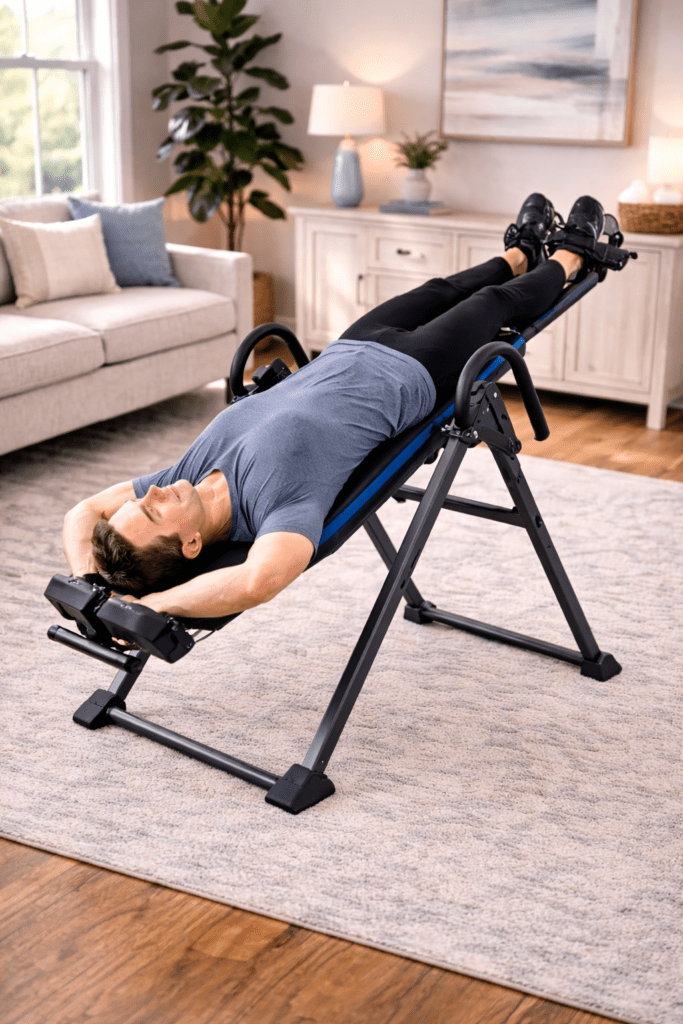
So What Should You Do Instead?
Here’s a simple, safe approach:
Start Slow
10–30° is plenty at first.
Keep Sessions Short
1–3 minutes is usually enough.
Focus on Mild Angles First
Only increase when your body tolerates it.
Pay Attention to Your Ankles
Comfort matters — if your ankles hurt, you’ll avoid inversion.
Build a Broader Routine
Pair decompression with strengthening and mobility.
If you’re comparing different tables — especially those with comfortable ankle systems or stable angle control — these pages are helpful:
- https://www.inversionexpert.com/teeter-inversion-table/
- https://www.inversionexpert.com/innova-fitness-itx1200-inversion-table/
Common Risks to Keep in Mind
Inversion isn’t dangerous for most healthy adults — but it does affect your circulation and nervous system. That means:
- It can raise blood pressure temporarily
- Eye pressure can increase (important for glaucoma)
- Head and ear pressure change
- It isn’t suitable for certain medical conditions without clearance
Always err on the side of caution. Better a shorter, gentler session than forcing deeper angles and suffering the next day.
Realistic Expectations
Here’s the honest truth:
- Inversion can relieve back tension — especially when used correctly.
- It doesn’t “fix” structural issues — like herniated discs or arthritis.
- It’s a tool, not a cure — it helps but doesn’t replace strength, mobility work, or posture habits.
- Short, gentle sessions outperform aggressive hanging — especially over time.
If you use inversion with mindfulness and consistency, you’ll get more benefits and fewer side effects.
Frequently Asked Questions
How long should my inversion session be?
Most beginners feel relief in 1–3 minutes. Advanced users can go up to 5 minutes if tolerated well.
Do I need to invert all the way upside down?
No. Most benefits occur at partial angles (20–60°). Full inversion isn’t necessary and increases risk for things like headache or head pressure.
Why do my ankles hurt?
Often it’s uncomfortable ankle supports or too tight locking. Consider a table with ergonomic ankle cuffs.
Is dizziness normal?
Mild lightheadedness right after rising can happen — but if it lingers or is intense, that’s a sign to slow down or reduce angle.
Can inversion make back pain worse?
If used improperly — yes. Too steep, too long, or ignoring discomfort can worsen pain. Start gentle and back off if symptoms increase.
Reputable Resources for More Information
- WebMD – Overview and safety of inversion therapy
- Cleveland Clinic – Inversion therapy benefits and considerations
- Mayo Clinic – Spinal traction and back pain treatment options
Conclusion: Fix the Patterns, Not Just the Pain
The difference between beneficial inversion and painful inversion often comes down to how you use it. Too many people associate “more angle” with “better results,” and that’s just not true for most of us.
If you’re experiencing any of the signs above — headaches, ankle pain, dizziness, increased back pain, or racing blood pressure — don’t ignore them. They’re your body’s way of saying, “Let’s try this differently.”
Inversion is an effective back relief tool — but only when used carefully, aligned with your body’s signals, and integrated into a broader routine of mobility and strengthening.