
If you’re dealing with back pain, stiffness, or that “compressed” feeling at the end of the day, you’ve probably looked at two very different options:
- Buy an inversion table and handle decompression at home
- See a chiropractor for adjustments
I’ve worked with people who’ve done both. Some swear by their chiropractor. Others love the control of daily inversion at home. And some use both strategically.
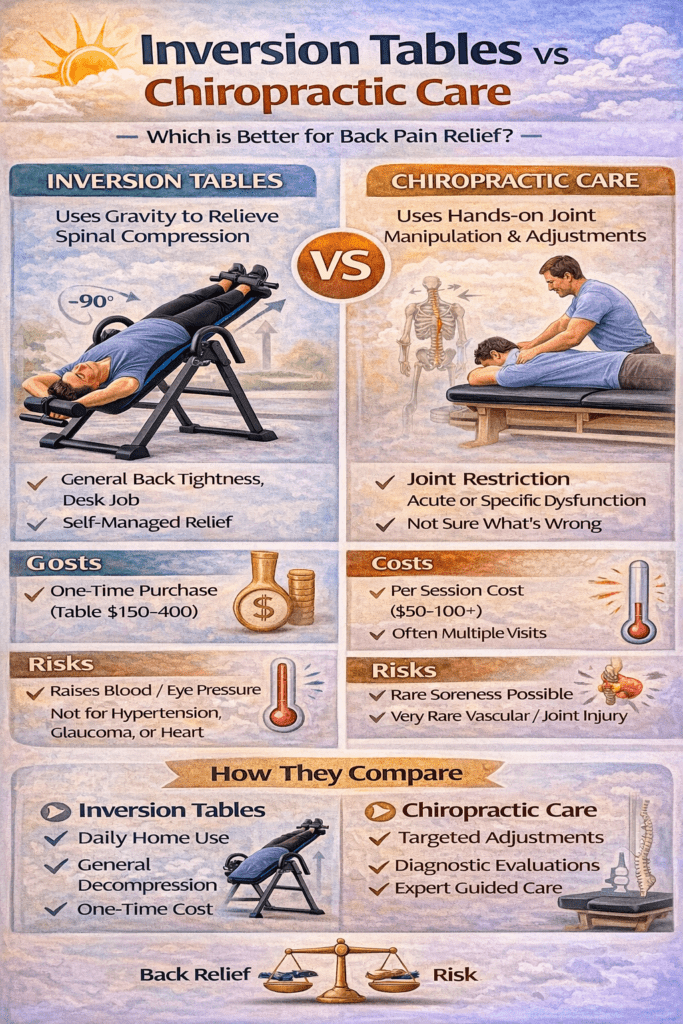
The real question isn’t which one is “better.” It’s: Which one fits your body, goals, and situation? Let’s break it down realistically.
What Inversion Tables Actually Do
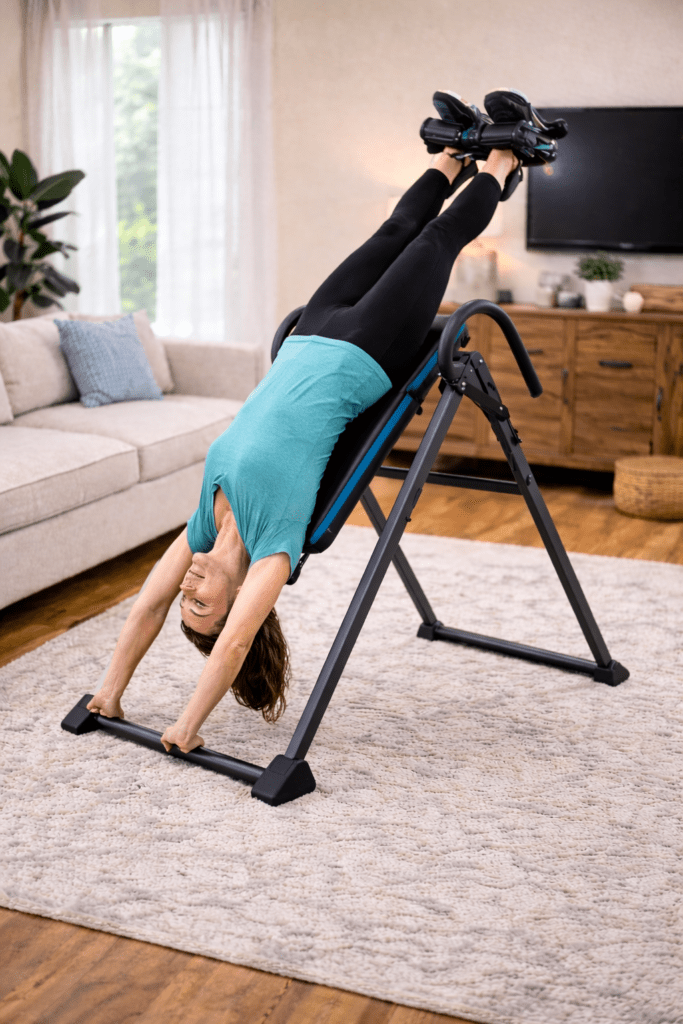
Inversion tables use gravity to gently decompress the spine. When you tilt backward:
- Disc spaces may temporarily widen
- Spinal muscles relax
- Compression from sitting or standing decreases
- You often feel lighter and looser afterward
It’s passive decompression. You’re not being “adjusted.” You’re simply letting gravity stretch your spine.
If you’re new to inversion basics, this overview helps:
https://www.inversionexpert.com/inversion-table-benefits/
What I like about inversion:
- You control the angle
- Duration is up to you
- You can use it daily
- It’s a one-time purchase
But it doesn’t “realign” joints or perform specific manual corrections.

What Chiropractic Care Actually Does
Chiropractors use manual adjustments (or instruments) to apply targeted force to joints in the spine.
The goal:
- Improve joint mobility
- Reduce pain
- Restore movement patterns
- Address specific segmental dysfunction
A skilled chiropractor can identify areas of restriction and apply precise adjustments that inversion cannot replicate.
Inversion is broad decompression.
Chiropractic is targeted joint mobilization.
Very different tools.
When Inversion Makes More Sense
Inversion may be a strong choice if:
- You feel general spinal compression
- Pain worsens after long sitting
- You want a daily decompression tool
- At-home control is preferred
- You’re looking for a lower long-term cost solution
For example, many people with desk jobs find 2–4 minutes at 20–30° dramatically reduces evening stiffness.
Tables like the Innova ITX9600 offer simple angle control and stability:
https://www.inversionexpert.com/innova-fitness-itx9600-good-or-bad/
Or if comfort is important (especially ankles), models like:
https://www.inversionexpert.com/innova-itm5900/
can make daily use easier.
Inversion is especially helpful for people who need frequent decompression but don’t necessarily need joint manipulation.
When Chiropractic Care Makes More Sense
Chiropractic care may be better if you:
- Have acute joint restriction
- Feel “locked up” in a specific area
- Have limited rotational mobility
- Have been evaluated and diagnosed with mechanical dysfunction
- Prefer professional guidance
If your issue involves specific spinal segments that aren’t moving properly, inversion alone may not address that. Adjustments can sometimes provide immediate mobility gains that passive traction cannot.
The Cost Comparison
Inversion Table:
- One-time purchase
- Long-term access
- No per-session fee
Chiropractic Care:
- Per-visit cost
- Often requires multiple sessions
- May involve ongoing maintenance visits
If you plan on decompression multiple times per week, inversion may become more economical over time. But if you need targeted correction or evaluation, chiropractic may justify its cost.
Risks and Trade-Offs
We need to talk about safety honestly.
Inversion Risks
Inversion temporarily:
- Raises blood pressure
- Increases eye pressure
- Shifts circulation toward the head
People with:
- Hypertension
- Glaucoma
- Heart conditions
- Vertigo
- Certain vascular conditions
should consult a healthcare provider before using inversion.
Chiropractic Risks
While generally safe when performed by licensed professionals, risks can include:
- Temporary soreness
- Rare joint irritation
- In very rare cases, vascular complications (especially with cervical manipulation)
Neither option is risk-free. Both require thoughtful decision-making.
Realistic Expectations
Let’s level-set expectations.
Inversion:
- Does not permanently “realign” the spine
- Will not fix disc degeneration
- Cannot strengthen muscles
Chiropractic:
- Does not permanently hold joints in place without supportive exercise
- Won’t eliminate the need for movement and strengthening
- Often requires repeated visits
Both approaches can relieve symptoms. Neither replaces strengthening, mobility work, or lifestyle changes. The most successful outcomes happen when:
- Decompression reduces pain
- Mobility improves
- Strength supports the change
Can You Combine Both?
Absolutely.
Some people:
- See a chiropractor during flare-ups
- Use inversion between visits to maintain decompression
Others:
- Use inversion daily
- Only see a chiropractor occasionally for assessment
The key is listening to your body and avoiding overdoing either approach.
For example, doing deep inversion immediately after a forceful adjustment might not always be ideal. Timing matters.
Who Should Probably Choose Inversion First?
- Budget-conscious users
- People with general compression pain
- Desk workers
- People who want daily relief
- Those comfortable with self-managed routines
Who Should Probably See a Chiropractor First?
- Acute injury
- Severe joint restriction
- Neurological symptoms
- Complex spine history
- Uncertain diagnosis
If symptoms involve numbness, weakness, or radiating pain, professional evaluation is wise before trying inversion.
Frequently Asked Questions
Is inversion as effective as chiropractic adjustments?
Not for targeted joint manipulation. Inversion provides decompression; chiropractic provides segmental mobilization.
Can inversion replace chiropractic visits?
For some people with general compression pain, yes. For joint-specific dysfunction, often no.
Is one safer than the other?
It depends on your health profile. Inversion affects blood pressure and eye pressure. Chiropractic carries rare but possible joint or vascular risks.
Can I use inversion after a chiropractic adjustment?
Usually yes, but mild angles are safer. Always follow your provider’s guidance.
Which gives faster relief?
Chiropractic can provide immediate mobility changes. Inversion can provide immediate decompression relief. It depends on your condition.
Reputable Resources for More Information
- Cleveland Clinic – Inversion therapy overview and safety
- Mayo Clinic – Chiropractic care and back pain guidance
- National Institutes of Health – Research on spinal manipulation
- WebMD – Overview of spinal traction and decompression
Conclusion: Tool vs Technique
Inversion tables and chiropractic care are not competitors — they’re different tools.
Inversion is:
- Consistent
- Accessible
- Passive decompression
Chiropractic is:
- Targeted
- Diagnostic
- Professional joint mobilization
If you’re managing everyday spinal compression, inversion can be a powerful, affordable tool.
If you’re dealing with joint restriction, acute dysfunction, or complex pain patterns, chiropractic care may be the better starting point. The smartest approach is matching the tool to the problem — not choosing sides.