
If you already use an inversion table — or you’re thinking about adding one — one of the most common questions I hear is:
“Should I invert in the morning or at night?”
And the honest answer? It depends on what you’re trying to get out of it.
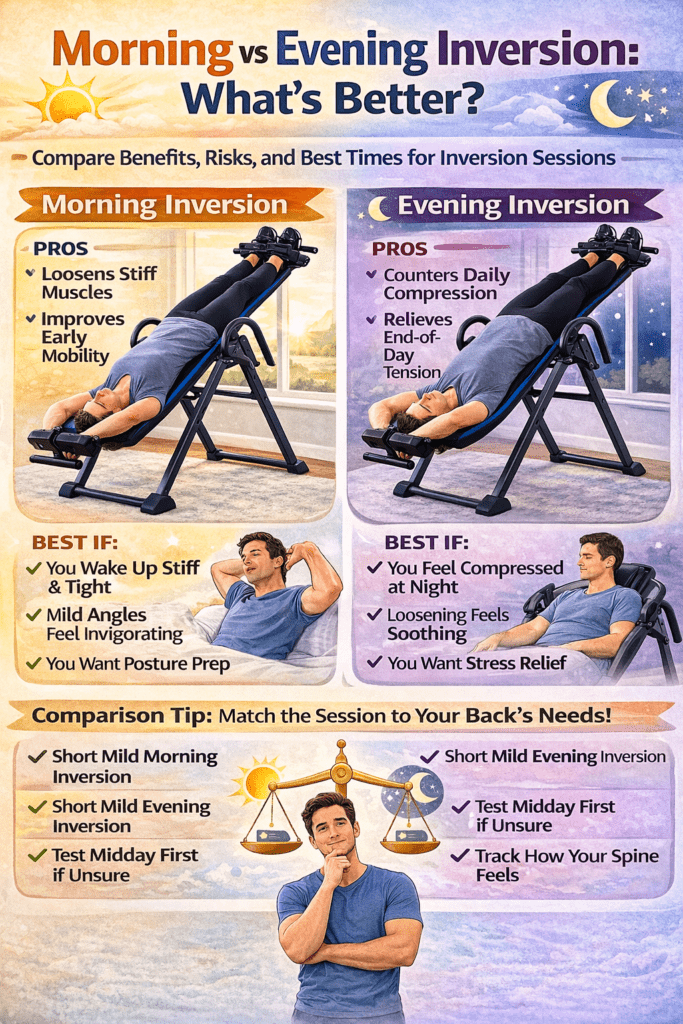
I’ve personally experimented with both for years, and I’ve watched clients respond differently depending on their schedule, stress levels, pain patterns, and sleep habits. Inversion isn’t just about decompression — it’s about timing your decompression to support your day.
Let’s break it down.
What Inversion Actually Does (Quick Refresher)
When you tilt backward on an inversion table:
- Gravity helps decompress the spine
- Muscles relax under gentle stretch
- Circulation shifts toward the upper body
- You get short-term pressure relief
If you’re new to inversion, start with a safety overview like this:
Now let’s talk timing.
Morning Inversion: The Pros and Cons
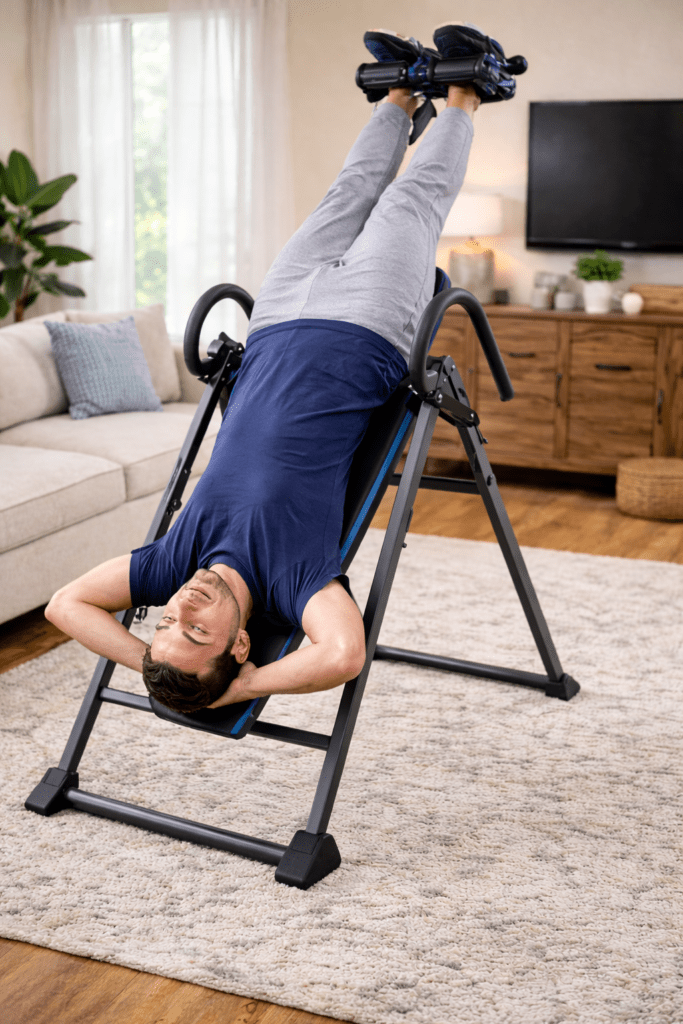
Why Morning Inversion Can Feel Great
Your spine is naturally more hydrated and slightly decompressed when you wake up. Overnight, your discs absorb fluid. That’s why most people are slightly taller in the morning.
Mild inversion in the morning can:
- Loosen stiff muscles
- Improve mobility before sitting or commuting
- Reduce that “first movement” back tightness
- Help posture before the day begins
If you’re someone who wakes up stiff, 2–3 minutes at a mild angle (20–30 degrees) can feel like flipping the reset switch.
Many beginners using models like:
find morning sessions easier to stick to because it becomes part of a routine.
Morning Trade-Offs
But here’s the nuance.
Your discs are most hydrated in the morning. That means they’re also slightly more vulnerable to aggressive flexion or heavy loading early in the day.
Full vertical inversion immediately upon waking?
Not something I recommend.
Keep it mild. Keep it short. Also, if you tend to experience head pressure with inversion, mornings may amplify that slightly because your body hasn’t fully adjusted to upright circulation yet.
Evening Inversion: The Pros and Cons
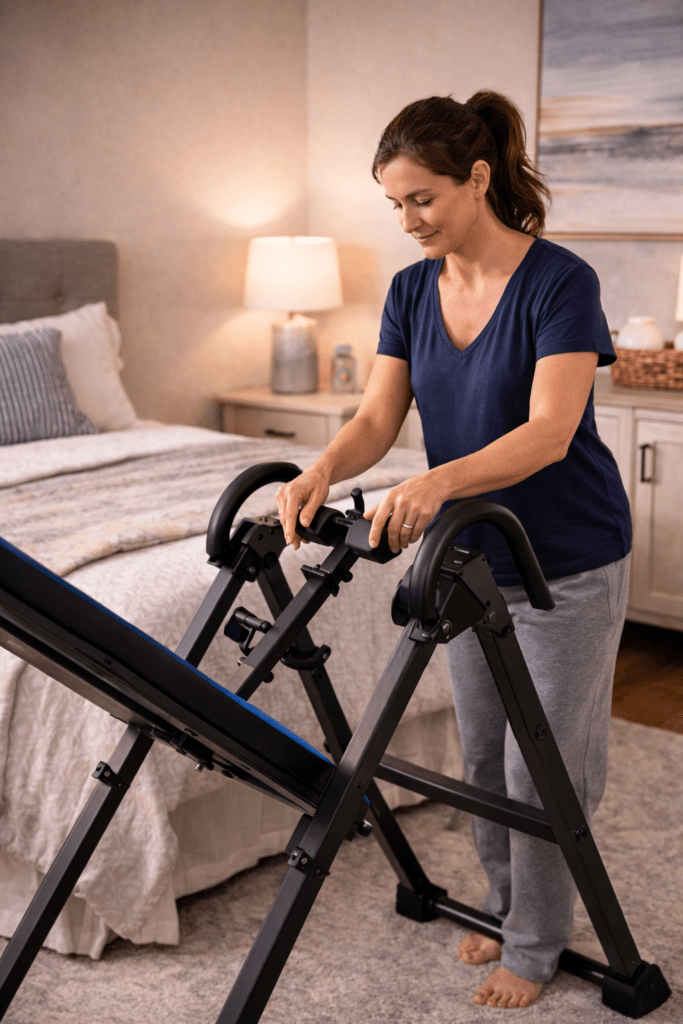
Now let’s look at night sessions.
Why Evening Inversion Works Well
By evening, your spine has been under compression all day — especially if you sit at a desk.
Evening inversion can:
- Counteract daily spinal compression
- Relax tight hip flexors and lumbar muscles
- Reduce stress tension
- Create a calm “wind-down” effect
Many users find that mild inversion (20–40 degrees) before bed helps them feel lighter and less stiff.
For those using comfort-focused tables like:
the added heat feature can enhance that relaxation effect.
Evening Trade-Offs
Here’s the catch. Inversion shifts blood toward your head. Some people feel energized afterward — not sleepy.
If you’re sensitive to:
- Head pressure
- Mild headaches
- Sinus pressure
late-night inversion can interfere with falling asleep. In rare cases, people report feeling “alert” instead of relaxed after deeper angles.
That’s why I recommend testing evening inversion earlier — say 1–2 hours before bed — instead of right before lights out.

Which Is Better for Back Pain?
If your pain pattern is:
Morning stiffness dominant:
Morning inversion usually wins.
End-of-day compression dominant:
Evening inversion tends to feel better.
Sciatic or nerve irritation:
Timing matters less than angle control. Keep it mild and consistent. If you’re unsure about how your body responds to decompression generally, reviewing broader use cases helps:
Realistic Expectations
Let’s stay grounded.
Inversion:
- Cannot permanently fix discs
- Will not “realign” your spine
- Does not replace strengthening
It provides temporary decompression.
The best results come when inversion supports:
- Core endurance work
- Hip mobility
- Postural awareness
- Smart lifting habits
Think of inversion as creating breathing room — not solving the root cause.
Risk Considerations (Morning vs Evening)
Regardless of timing, remember inversion:
- Raises blood pressure temporarily
- Increases eye pressure
- May cause dizziness
People with:
- Hypertension
- Glaucoma
- Heart conditions
- Vertigo
- Sinus issues
should consult a healthcare provider before using inversion. Timing won’t eliminate those physiological effects — it only changes how your body feels when they happen.
My Personal Rule of Thumb
If your goal is:
- Mobility and posture prep → Morning
- Relaxation and decompression → Evening
- Testing tolerance → Midday first
I often suggest new users try both for one week each. Keep angles consistent. Keep session length consistent (2–5 minutes). Then compare how your body responds. Your body will tell you.
Frequently Asked Questions
Is it safe to invert twice per day?
For most healthy individuals, mild inversion twice daily (short sessions) is tolerated well. Always start gradually.
Is morning inversion dangerous because discs are hydrated?
Not dangerous — but avoid deep angles immediately upon waking. Mild angles are smarter.
Can evening inversion improve sleep?
For some, yes – it reduces tension. For others, head pressure may interfere with sleep. So, test carefully.
How long should sessions last?
Most people benefit from 2–5 minutes. Longer isn’t necessarily better.
Is full inversion necessary?
No, many users get results at 20–45 degrees.
Reputable Resources for More Information
- Cleveland Clinic – Inversion therapy overview and safety considerations
- WebMD – Spinal traction and decompression safety guidance
- Mayo Clinic – Back pain management best practices
- American Academy of Orthopaedic Surgeons – Spine health basics
Conclusion: It’s About Fit, Not Formula
There’s no universal winner between morning and evening inversion.
The better question is:
When does your spine need decompression most?
If you wake up stiff, morning sessions can set your day up well. However, if you finish the day compressed and tight, evening sessions may be your release valve.
The smartest approach is not guessing — it’s testing carefully, keeping sessions mild, and building a routine that supports movement and strength. Inversion works best when it complements a strong spine — not replaces one.