
If you’re over 60 and thinking about an inversion table, you’re already asking the right question: “How do I get the benefits without taking unnecessary risks?” That’s the whole game.
I’ve helped a lot of older adults (and plenty of cautious beginners) ease into inversion safely, and here’s my straight take: inversion can be a great “pressure relief” tool for the back when it’s gentle, controlled, and consistent—but seniors need the right table and the right approach. You don’t want a wobbly frame, painful ankle clamps, or a setup that feels like a gymnastics event just to get on and off.
Also—important reality check—your 60s and 70s are when conditions like blood pressure issues, glaucoma, osteoporosis, balance problems, or joint arthritis become more common.
Those can change whether inversion is appropriate at all. Cleveland Clinic specifically notes inversion can increase pressure in the skull and flags several conditions where you should talk to a clinician first (blood pressure issues, heart disease, glaucoma/eye disease, reflux, pregnancy, stroke history, and more).
So: let’s cover what to look for, which tables tend to work best for seniors, and what “realistic results” look like.
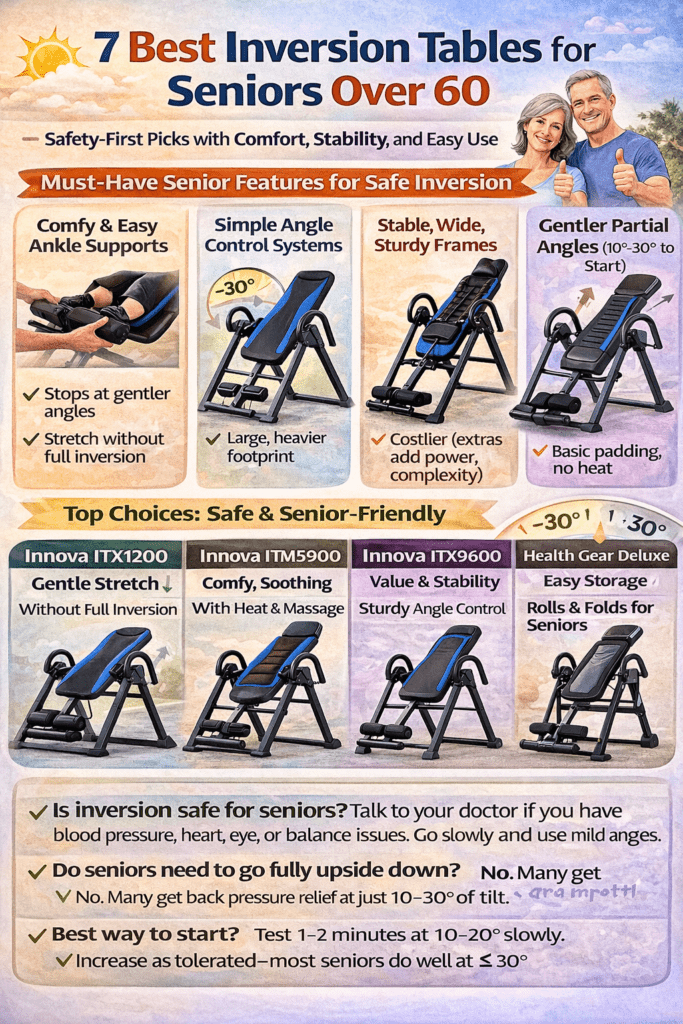
What Matters Most for Seniors (Over 60)
1) Easy ankle system (comfort + simple lock)
If your ankles hurt, you won’t use the table. Period. Look for ergonomic ankle cuffs and easy closures rather than skinny foam bars.
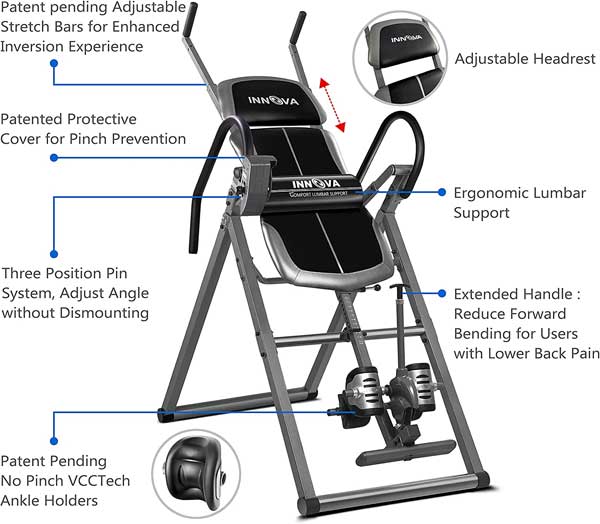
A good example is the Innova ITM5900, which highlights ergonomically designed cuffs meant to reduce ankle pressure and a quick pin-angle system.
2) Angle control you can repeat
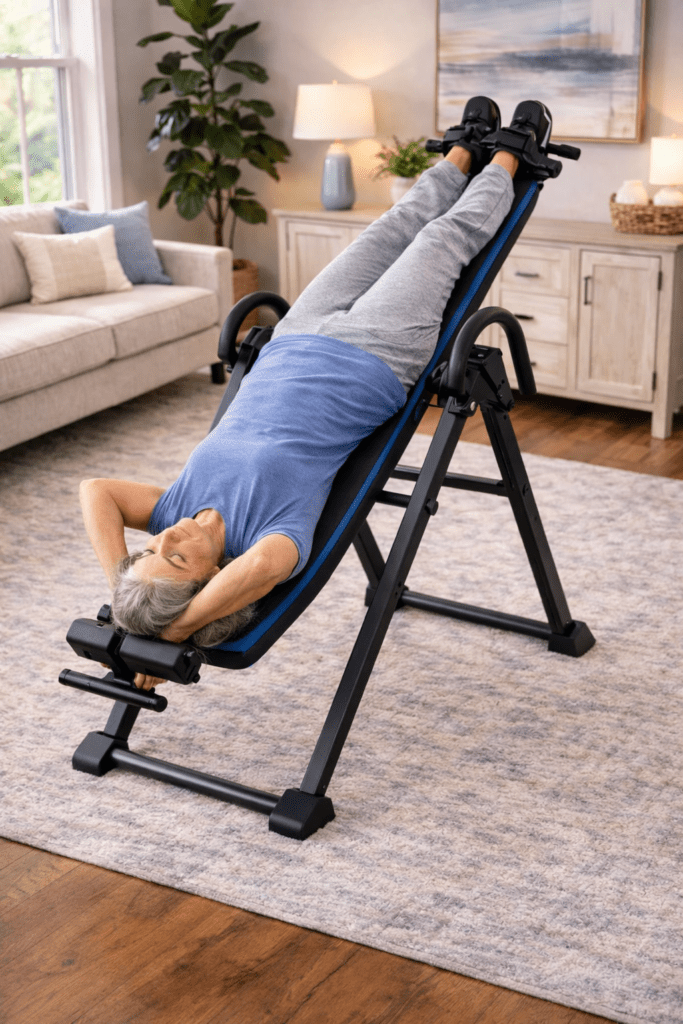
Seniors do best with partial inversion (think 10–30° to start). Pin systems are faster and more consistent than straps.
WebMD even suggests as little as 10 degrees for older adults, plus short sessions and slow returns to upright.
3) Stable frame + wide base
You want the table to feel “planted,” not tippy. Extra-wide backrests and solid steel frames help.
4) Lower “intimidation factor”
The best senior inversion table is the one you’ll actually use calmly—without fear or struggle getting in/out.
Best Inversion Tables for Seniors Over 60
1) Innova ITX1200 (Best for gentle inversion without going fully upside down)
If I’m choosing for a cautious senior, this design style is a standout because you can get a full-body stretch without needing full 180° inversion, and it’s positioned as allowing longer, lower-incline stretching with less head pressure.
https://www.inversionexpert.com/innova-itx1200-inversion-table/
Why seniors like it: less steep, more controlled stretching
Trade-off: larger/heavier footprint than basic tables
2) Innova ITM5900 Heat & Massage (Best for comfort + soothing features)
Seniors who deal with tight lumbar muscles often love a little extra comfort. The ITM5900 emphasizes upgraded ankle cuffs and a quick pin-angle system.
https://www.inversionexpert.com/innova-itm5900/
Why seniors like it: comfort upgrades help you stay consistent
Trade-off: “extras” add cost and complexity (and some features may require power)
3) Innova ITX9600 (Best value: sturdy + simple angle control)
This model is described as heavy-duty with a “True Balance” feel and a pin system for consistent angles.
https://www.inversionexpert.com/innova-fitness-itx9600-good-or-bad/
Why seniors like it: stable, straightforward, good bang-for-buck
Trade-off: not as plush as premium comfort models
4) Innova ITX9700 (Best “cushiony feel” on a budget)
If someone says, “I want comfort but I don’t want to overspend,” the ITX9700 is often appealing. It’s presented with a memory foam bed, lumbar pad, and pin-style positioning.
https://www.inversionexpert.com/innova-fitness-itx9700/
Why seniors like it: softer feel makes sessions more pleasant
Trade-off: still need to pay attention to safe angles + session length
5) Health Gear Deluxe (Best for easy storage/moving around)
Some seniors care less about fancy features and more about “Can I move this without wrestling it?” This model notes it can fold and roll for storage, and includes a pin system with multiple angle settings.
https://www.inversionexpert.com/health-gear-deluxe-inversion-table/
Why seniors like it: convenient storage and repeatable angle settings
Trade-off: comfort level varies by person—ankles are still a big factor
Trade-Offs and Risks Seniors Should Take Seriously
Here’s the non-negotiable: inversion changes circulation.
WebMD notes inversion can slow heart rate and raise blood pressure, and increase pressure in your eyes—making it risky for people with high blood pressure, glaucoma/eye disease, heart disease, stroke history, hiatal hernia, inner ear problems, pregnancy, and more.
Cleveland Clinic also warns about increased pressure in the skull and advises speaking with your healthcare provider if you have risk factors.
For seniors specifically, I’d also be cautious if you have:
- Osteoporosis or fracture risk
- Balance/vertigo issues
- Significant knee/hip arthritis (ankle locking + joint angles matter)
If any of those are on your radar, don’t “power through.” Get clearance and consider alternatives like gentle PT-led traction or mobility work.
Realistic Expectations (What You’ll Probably Notice)

Most seniors who do well with inversion report:
- Short-term decompression relief (especially after sitting)
- Looser hips/low back
- Less end-of-day stiffness
What it usually won’t do by itself:
- Permanently “fix” discs or arthritis
- Replace core strength, walking, and mobility habits
Cleveland Clinic puts it well: don’t expect a magic bullet; it can complement a broader plan, and longer-term improvement (if it happens) may take weeks of consistent use.
A Safe Starter Plan for Seniors (Simple and Repeatable)
A practical approach (aligned with WebMD’s conservative guidance):
- Angle: start at 10–20°
- Time: 1–2 minutes once daily
- Progress: add time slowly up to 3–5 minutes max
- Rule: come up slowly every time
Frequently Asked Questions
Is an inversion table safe for seniors over 60?
Sometimes—if you’re medically cleared and you use mild angles and short sessions. If you have blood pressure issues, glaucoma, heart disease, stroke history, vertigo, or similar concerns, talk to your clinician first.
Do seniors need full inversion to get benefits?
No. Partial inversion (10–30°) can still feel decompressing, and WebMD specifically advises older adults to start as low as 10°.
What features matter most for older adults?
Comfortable ankle support, stable frame, and easy angle control (pins are usually simpler than straps).
How often should I use it?
Most people do best with short, consistent sessions (a few minutes). If you feel worse afterward, back off.
Reputable Resources for More Information
- Cleveland Clinic: inversion tables, realistic expectations, and risks
- WebMD: how to start safely, side effects, who should avoid
Conclusion
For seniors over 60, the “best” inversion table is the one that feels stable, comfortable at the ankles, and easy to control at mild angles. If you’re cautious and consistent, inversion can be a helpful decompression tool—especially for stiffness from sitting—without needing full upside-down sessions.
If you want a quick shortlist to start with:
- Most senior-friendly gentle option: https://www.inversionexpert.com/innova-itx1200-inversion-table/
- Comfort upgrade (ankles + angle control): https://www.inversionexpert.com/innova-itm5900/
- Simple sturdy value pick: https://www.inversionexpert.com/innova-fitness-itx9600-good-or-bad/
- Convenient fold/roll storage style: https://www.inversionexpert.com/health-gear-deluxe-inversion-table/